
Why India’s Freebie Debate Needs a Better Test
More than two thousand years ago, Aristotle compared repeated public assistance without lasting improvement to water poured into a leaking cask. But his argument in Politics did not end there. He also supported assistance that could help poor people acquire land or begin a trade. The concern was how public money could create lasting prosperity. That question still holds a significant place in the modern debate on welfare. [1]
In India, this debate is commonly described as the debate on freebies. Supporters view free services and cash transfers as instruments of social justice. Critics argue that election promises can place a permanent burden on public finances without solving the problems that make assistance necessary.
Both concerns deserve attention. A family struggling to buy food cannot wait for economic growth to reach its doorstep. At the same time, a government cannot keep announcing benefits without explaining how it will pay for them. The real question is what support people need, how it should be delivered, and how much the state can responsibly sustain.
How Election Promises Became a National Debate
In 2006, M. Karunanidhi's DMK promised free colour televisions in its Tamil Nadu election manifesto. The subsequent distribution became a major legal controversy. In 2011, competing promises included laptops, household appliances, rice, livestock and marriage assistance. These schemes reached the Supreme Court in S. Subramaniam Balaji v. State of Tamil Nadu, decided on 5 July 2013. The Court declined to invalidate the challenged schemes. [2]
This episode made the issue prominent, but it should not be described as the first distribution of freebies in India. Such a claim assumes that everybody agrees on what a freebie is. They do not.
Purpose Matters More Than the Label
Free school meals and a television are both supplied without a direct payment by the recipient. Their purposes and effects may be very different. Even the same item can have different value: a laptop connected to teaching and digital access may remove an educational barrier, while poorly planned distribution may achieve little.
Economists use the idea of merit goods for services, such as education and preventive healthcare, whose wider benefits justify public support. But cash is a method of delivery, not proof of waste. An unconditional transfer means there is no behavioural requirement, such as school attendance; it can still have income, age or other eligibility conditions. Each scheme needs examination on its own terms.
What the Constitution and Election Law Permit
The Constitution requires a serious welfare commitment. Article 38 addresses welfare and inequality; Article 41 makes public assistance subject to economic capacity and development; Article 47 concerns nutrition and public health. Article 45 now concerns early childhood care and education below six years, while Article 21A protects free and compulsory education for children aged six to fourteen. [3]
These provisions support social spending, but do not excuse every scheme from scrutiny. Article 14 requires equality and protection against arbitrary state action. Article 15(3) permits special provisions for women and children. A women-focused benefit is therefore not automatically discriminatory; its eligibility rules and purpose still matter. [3]
Funding Rules and Legislative Accountability
Article 266(3) requires constitutional and legal authority for withdrawals from the Consolidated Fund. Article 282 allows grants for a public purpose, including beyond the government's legislative subjects. Neither provision establishes a blanket prohibition on free benefits. [3] Legislative approval is necessary, but a budget vote alone cannot cure unconstitutional discrimination. Equally, describing expenditure as politically attractive does not establish that it is unlawful.
What the Supreme Court Decided in Balaji
In Balaji, the Court held that manifesto promises did not constitute corrupt practices under Section 123 of the Representation of the People Act, 1951, as then framed. It recognised the state's policy role, while expressing concern about electoral influence and directing the Election Commission to frame guidelines. The decision was not a declaration that every future promise must be valid. [2]
Section 170 of the Bharatiya Nyaya Sanhita, 2023 addresses electoral bribery, but expressly excludes a declaration of public policy or a promise of public action. [4] Offering a voter cash for a vote and proposing a publicly funded welfare programme are therefore legally distinct. The distinction does not mean that merely calling an inducement a scheme makes it lawful.
What Voters Should Be Told About Funding
The Election Commission's Model Code expects manifestos to explain the rationale for promises and broadly indicate how they will be financed. It recognises welfare commitments while cautioning against promises that undermine electoral fairness. [5] This creates an obvious accountability question: can voters meaningfully assess a promise when the benefit is specific but its funding remains vague?
On 26 August 2022, a bench headed by then CJI N. V. Ramana referred the wider freebies dispute, including the request to reconsider Balaji, to a three-judge bench. Its order acknowledged both welfare obligations and fiscal concerns. [6] A reference for reconsideration must not be confused with a judgment overturning the earlier ruling.
Why Parties Promise Benefits—and Why Voters Value Them
Why Visible Benefits Shape Political Choices
A monthly transfer is visible. A household can see the payment and identify the government providing it. Better groundwater management or stronger primary education may take years to show results. This creates an incentive to favour benefits whose political returns arrive quickly.
Competition strengthens that incentive. Once one party announces a benefit, its rivals may feel pressure to match or increase it. A temporary electoral promise can then become a recurring obligation which no government wants to withdraw.
Why Recipients’ Choices Deserve Respect
But voters are not simply being purchased. For people facing irregular wages, unpaid care work or insecure employment, immediate assistance has a practical value. Supporting a party because its programme improves one's life is also part of democratic choice.
The danger arises when political competition becomes a contest over the size of payments, with little discussion of funding or results. Accountability should therefore focus on the promise and its delivery, rather than treating beneficiaries as incapable of making political judgments.
What State Budget Figures Show
Start with the Reference Period
The Economic Survey 2025–26 estimated aggregate spending on unconditional cash-transfer programmes, particularly for women, at approximately Rs 1.7 lakh crore for FY2025–26. It stated that the number of states implementing them increased more than fivefold between FY2022–23 and FY2025–26. This is a fivefold increase in the number of states, not a verified fivefold increase in expenditure. [7]
The following figures provide a comparable illustration from the same financial year. They are original budget allocations, not audited expenditure or estimates for the current year.
| State | Scheme | Budget allocation |
|---|---|---|
| Maharashtra | Mukhyamantri Majhi Ladki Bahin | Rs 36,000 crore [8] |
| Karnataka | Gruha Lakshmi | Rs 28,608 crore [9] |
| Tamil Nadu | Magalir Urimai Thogai | Rs 13,807 crore [10] |
What the Combined Figure Does—and Does Not—Mean
Together, these allocations total Rs 78,415 crore. That is not India's total spending on freebies, and it should not be added to the Survey's aggregate, which could double-count the same programmes. Nor does a large allocation, by itself, establish poor value.
The relevant comparison is with each state's resources and obligations. Maharashtra's allocation was about 6% of its estimated revenue receipts. Its FY2025–26 budget also projected a revenue deficit of Rs 45,891 crore. [8] These figures show a substantial competing claim on resources; they do not prove that one scheme caused the entire deficit.
Annual allocations, revised estimates, actual payments and spending since a scheme began answer different questions. Adding them together produces an impressive total but weak analysis. The same caution applies to dividing state expenditure by India's population: that calculation is not a bill paid equally by every citizen.
When Welfare Becomes a Fiscal Risk
Understand the Fiscal Measures
A fiscal deficit is broadly the gap between expenditure, excluding debt repayment, and receipts other than borrowing. A revenue deficit means that revenue expenditure exceeds revenue receipts. Debt is the accumulated stock of liabilities. These are related measures, but they are not interchangeable.
GSDP measures a state's economic output, not the money available in its treasury. The danger does not begin only when expenditure exceeds GSDP. A state can face serious difficulty much earlier if interest, salaries and other commitments absorb its income and essential bills remain unpaid.
The Economic Survey reported states' combined fiscal deficit at 3.2% of GDP in FY2024–25 provisional accounts, against 2.6% in FY2021–22. It placed outstanding liabilities at about 28.1% of GDP in FY2024–25. [7] These are aggregate indicators, not proof that cash transfers caused the deterioration or that every state faces the same risk.
A June 2022 RBI Bulletin article by RBI staff identified rising non-merit freebies, contingent liabilities and distribution-company dues as fiscal risks. The authors' views were not presented as the RBI's institutional position. [11] Its warning remains useful: borrowing and unpaid obligations can hide the full cost of today's promises.
Where Hidden Costs Can Build Up
For electricity, a government should disclose and pay the subsidy it promises. If compensation is delayed, the burden can move to the distribution company, suppliers or other consumers. Unlimited support can also weaken incentives to conserve power; a basic lifeline allowance preserves a price signal above essential consumption.
Repeated loan waivers raise a different concern. If borrowers expect the next election to erase debt, timely repayment becomes less attractive. However, disaster relief after crop failure has a different justification from routine electoral cancellation. The policy should distinguish exceptional distress from permanent expectations of rescue.
What Cash Support Can—and Cannot—Do
What Transfers Can Achieve
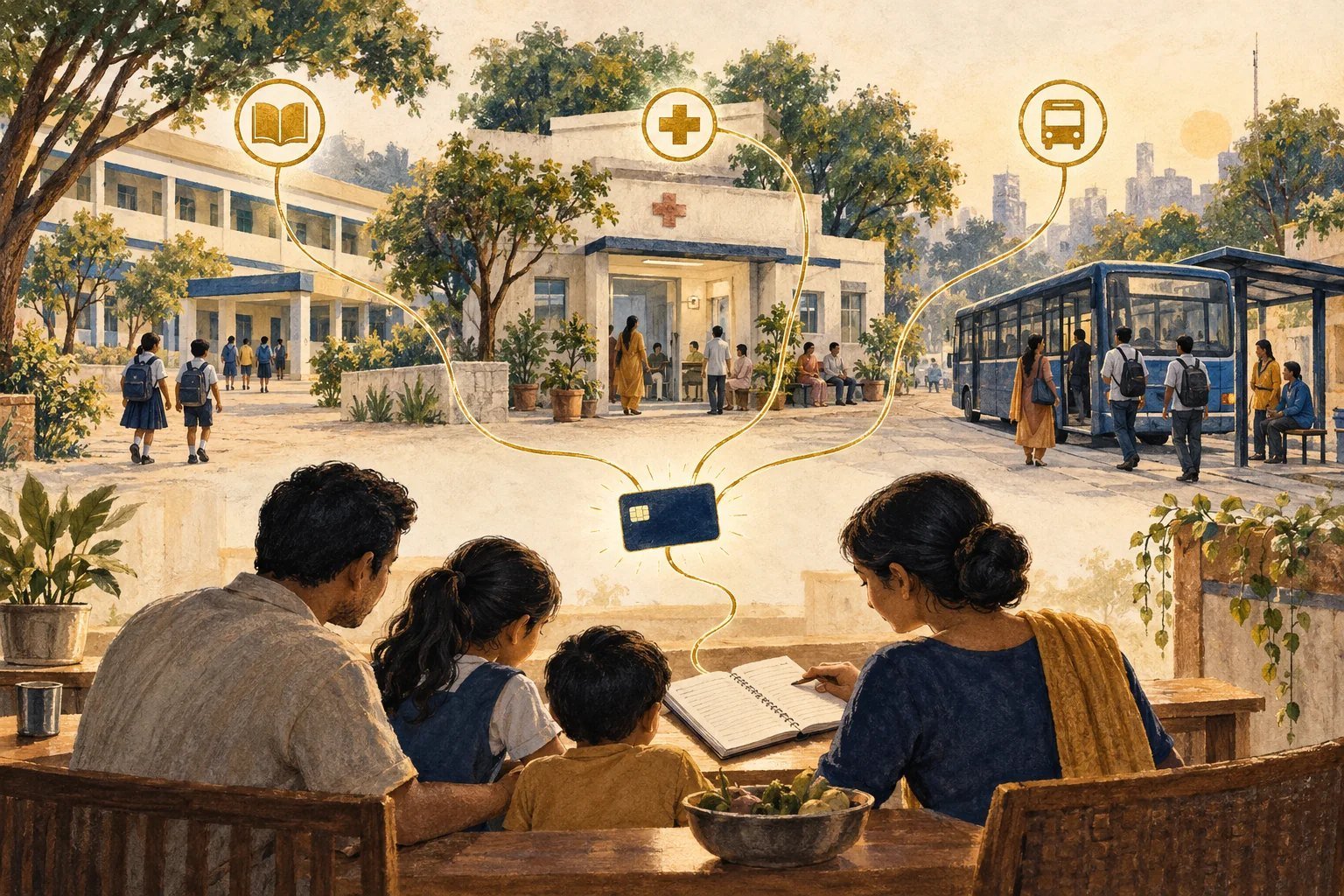
Cash support can help a household buy medicines, avoid expensive borrowing or keep a child in school. It also gives recipients flexibility: the government may not know whether the more urgent need is food, transport or a repair. Its value is not exhausted merely because it leaves no visible public building.
Claims that recipients necessarily stop working require evidence. Abhijit Banerjee, Rema Hanna, Gabriel Kreindler and Benjamin Olken re-examined seven randomised evaluations in six developing countries and found no systematic evidence that the studied cash-transfer programmes discouraged work. [12] This does not establish that every Indian scheme has no employment effect. It does show why a general accusation of laziness is insufficient.
The size of the payment, local job opportunities and withdrawal rules matter. Abruptly removing all assistance when earnings rise can discourage formal work. A gradual reduction may protect both income security and incentives.
Targeting also involves a trade-off. Restricting benefits to poorer households can save money, but income records may miss informal workers whose earnings change every month. Universal provision is easier to understand and can reduce exclusion, although it also subsidises people who could pay. The right choice depends on administrative capacity as well as the budget. A modest universal basic service and additional support for greater need may sometimes work better than an elaborate eligibility test.
Why Transfers Cannot Replace Public Services
Cash also has limits. A transfer cannot create a functioning clinic where none exists. The Economic Survey cautioned that transfers need complementary investments in services, skills and employment. [7] The sensible approach is to examine which combination helps people: immediate support, reliable public services and opportunities to earn.
Political Promises, “Revdi Culture” and Judicial Concerns
Reading Political and Judicial Criticism Carefully
On 16 July 2022, while inaugurating the Bundelkhand Expressway, Prime Minister Narendra Modi warned against “revdi culture”, linking electoral giveaways with risks to development. [13] His criticism brings opportunity cost into the debate: money committed to one programme cannot simultaneously fund another.
On 19 February 2026, during a case concerning electricity rules, CJI Surya Kant reportedly questioned indiscriminate benefits, their financial burden and possible effects on work. He also recognised the state's responsibility to empower marginalised people. These were reported oral observations, not a final judgment banning welfare transfers. [14]
Both interventions deserve discussion, but public authority cannot replace evaluation. A judicial concern about work incentives must still be tested against research. A political criticism of waste must apply equally to the critic's own spending commitments.
There is also a question of public trust. Citizens may lose confidence when taxes rise while services deteriorate and promises remain unexplained. Yet lower-income households also pay indirect taxes. Presenting welfare as a conflict between taxpayers and a separate, non-contributing class misstates that relationship. The stronger social contract is one in which everybody can ask where public money goes and what it achieves.
What International Experience Can Teach
Brazil and Colombia: Building Around the Transfer
Brazil's Bolsa Família links assistance with education and health requirements. World Bank reporting describes improvements to its targeting, monitoring and connections with other services. [15] The useful lesson is to build a system around the transfer, rather than assume that distributing money completes the government's responsibility.
There is evidence of measurable gains elsewhere. A World Bank review reported that rural beneficiaries of Colombia's Familias en Acción experienced a six-percentage-point improvement in the likelihood of completing secondary school over a ten-year horizon. [15] This is a programme-specific finding, not a promise that identical conditions will produce identical results in India.
Conditions also require care. Penalising a family for missing a health visit is unfair if the clinic has no staff. Elderly people and persons with disabilities may need continuing support without conditions designed for school-age children. Governments must make the service available before demanding its use.
Sri Lanka and Argentina: Avoiding Easy Causal Claims
Sri Lanka offers a different lesson. The IMF's 2023 assessment described a crisis involving longstanding vulnerabilities, large tax cuts, pandemic shocks, loss of market access and monetary financing. [16] Reducing this history to “freebies bankrupted the country” hides the interaction between revenue policy, external financing and economic shocks.
Argentina's end-2023 inflation reached 211.4%, according to IMF reporting. [17] Persistent fiscal and monetary problems provide a warning about financing credibility. But this does not establish a direct causal chain from an Indian state's cash-transfer scheme to comparable inflation. Indian states cannot issue their own currency, and their borrowing operates within a different institutional framework.
Additional spending can contribute to inflation when demand outpaces supply, depending on financing and economic conditions. It is not an automatic rupee-for-rupee recovery of a particular welfare budget through higher prices. International examples should explain risks, not manufacture certainty.
Compare Programmes with Their Alternatives
Make the Opportunity Cost Concrete
Opportunity cost should be made concrete. As a purely illustrative calculation, a Rs 10,000 crore annual programme spread across one crore eligible households provides Rs 10,000 per household per year, before administration costs. If only Rs 8,000 crore is sustainably available, the government must reduce the benefit, narrow coverage, raise revenue or identify another spending reduction. The missing Rs 2,000 crore cannot be solved by the announcement itself.
Alternative uses might include childcare centres, primary health staffing, buses, irrigation maintenance or remedial teaching. Which option is better depends on the local problem. Childcare may help a parent take paid work; a transfer may prevent immediate hunger. Neither advantage should be assumed without examining who benefits and what delivery costs.
There is also a problem with treating all revenue expenditure as waste and all capital expenditure as productive. Teachers, medicines and maintenance are recurring expenses. A new hospital without staff can perform worse than a properly funded existing clinic. Better spending means better outcomes, not merely a different accounting category.
Apply the Same Standard to Tax Concessions
Corporate concessions deserve the same scrutiny. A tax holiday has a public cost through revenue forgone, while a subsidy uses expenditure. Neither should receive automatic approval because it is called an investment, nor automatic rejection because it benefits a business. The test should examine additional jobs or investment, distribution of benefits, duration and results compared with what would have happened without the concession. Household transfers deserve an equally serious assessment.
A Practical Test for Responsible Welfare
There is no defensible universal percentage that separates welfare from waste across all states. Their revenues, debt burdens and needs differ. A practical test should begin before the promise becomes a permanent entitlement.
Six Questions Before a Promise Becomes Permanent
First, publish the problem and eligibility rules. Explain whether the scheme addresses poverty, a service barrier, unpaid care or another identifiable need. Include an accessible appeal process so that imperfect records do not exclude deserving people.
Second, disclose the full cost over several years, including administration and payments owed through public agencies. Show how the programme would survive weaker revenue growth. A borrowing assumption should not be disguised as assured income.
Third, apply state fiscal-responsibility laws and borrowing controls transparently. States have their own FRBM frameworks; Article 293(3) also requires Union consent for borrowing in the circumstances specified there. [18] Fiscal discipline should be predictable, with lawful space for shocks, rather than enforced selectively according to political alignment.
Fourth, protect essential services and evaluate results. Success should include reduced hardship, reliable access and improved opportunity, not simply the number of payments issued. Independent assessments should compare benefits with realistic alternatives.
For example, a transport subsidy should be assessed against whether people can reach work or education, as well as whether buses actually run. A laptop programme should examine use and learning, not just procurement. A cash scheme should measure whether recipients control the money and whether hardship falls. These questions make criticism specific enough to improve a programme instead of merely demanding its abolition.
Finally, review schemes periodically and redesign weak ones. Emergency assistance can expire, while continuing needs may justify continuing support. Changes should allow households time to adjust. A government should be able to defend both the decision to start a programme and the decision to continue it.
Balancing Immediate Support with Long-Term Capacity
The freebies debate becomes useful when it moves beyond defending or condemning every free benefit. India needs welfare that responds to present hardship and public investment that reduces future insecurity. These responsibilities have to be financed together.
Political parties should remain free to offer competing social priorities, but voters deserve the complete promise: who receives the benefit, what it costs, how it is funded and what it is expected to change. Public money is justified by the public purpose it actually serves. That is where both welfare and fiscal responsibility should meet.
Sources and Further Reading
- Aristotle, Politics, Book VI, chapter 5, 1320a–1320b. Read source ↗
- S. Subramaniam Balaji v. State of Tamil Nadu, (2013) 9 SCC 659, judgment dated 5 July 2013, especially paragraphs 84–89. Judgment text. Read source ↗
- Constitution of India, Legislative Department, edition as on 1 May 2024. Articles 14, 15(3), 21A, 38, 41, 45, 47, 266 and 282. Read source ↗
- Bharatiya Nyaya Sanhita, 2023, section 170, particularly the proviso to subsection (1). Statutory text reproduction. Read source ↗
- Election Commission of India, Model Code of Conduct, Part VIII, Guidelines on Election Manifestos. Read source ↗
- Ashwini Kumar Upadhyay v. Union of India, W.P.(C) 43/2022, Supreme Court order dated 26 August 2022, paragraphs 9–14. Read source ↗
- Government of India, Economic Survey 2025–26, chapter 2, Box II.7, printed pages 64–66. Estimates and provisional figures retain their original reference periods. Read source ↗
- PRS Legislative Research, Maharashtra Budget Analysis 2025–26, 1 April 2025, discussion of the revenue deficit and cash-transfer allocation. Read source ↗
- PRS Legislative Research, Karnataka Budget Analysis 2025–26, sector expenditure table. Read source ↗
- PRS Legislative Research, Tamil Nadu Budget Analysis 2025–26, sector expenditure table. Read source ↗
- Atri Mukherjee and others, State Finances A Risk Analysis, RBI Bulletin, June 2022, pp. 115–131. Staff research, carrying an author-views disclaimer. Read source ↗
- Abhijit V. Banerjee, Rema Hanna, Gabriel E. Kreindler and Benjamin A. Olken, Debunking the Stereotype of the Lazy Welfare Recipient, World Bank Research Observer 32(2), 2017, pp. 155–184. Read source ↗
- Prime Minister's Office, PIB release on the Bundelkhand Expressway inauguration, 16 July 2022. Read source ↗
- India Legal, Freebies will hurt states in the long run warns Supreme Court, 19 February 2026. Reporting of oral observations, not a final ruling. Read source ↗
- World Bank, Two decades transforming lives through Social Protection Programs in Latin America and the Caribbean, 4 June 2024. Read source ↗
- IMF, Sri Lanka Request for an Extended Arrangement, Country Report 23/116, March 2023, context and crisis assessment. Read source ↗
- IMF, Argentina Seventh Review, Country Report 24/37, February 2024, selected economic indicators and policy discussion. Read source ↗
- Ministry of Finance, Lok Sabha Unstarred Question 2500, Identification of High Stressed States, answered 1 August 2022. Read source ↗